
December 8, 2020
The Honourable Doug Downey Attorney General of Ontario McMurtry-Scott Building, 11th Floor 720 Bay St
Toronto, ON M7A 2S9
The Honourable Todd Smith
Minister of Children, Community & Social Services
7th Floor, 438 University Ave. Toronto, ON M5 G 2K8
Sent via email: Doug.downey@pc.ola.org, Todd.Smithco@pc.ola.org
Dear Attorney General Downey and Minister Smith,
RE: ALARMED FOR THE FUTURE OF THE SOCIAL BENEFITS TRIBUNAL AND APPEALS PROCESS
We are writing on behalf of the Steering Committee for Social Assistance, the community legal clinics’ working group made up of representatives from across the Province with the participation of specialty clinics including the Income Security Advocacy Centre (ISAC) and Community Legal Education Ontario (CLEO) as well as the Clinic Resource Office (CRO). The Steering Committee seeks opportunities to improve social assistance policies and procedures through ongoing communication with government, the community legal clinics, and other affected groups.
Governments, through the Ontario Disability Support Program and Ontario Works, have sought to support Ontarians with disabilities and others who would otherwise live in poverty. Understandably, the application and appeal process are constantly under scrutiny. However, we are concerned that the Social Benefits Tribunal is being severely curtailed, and we are alarmed by signals that it may be in the process of being eliminated.
Legal clinics are reporting that some of their clients will have to wait until 2022 to get their appeals heard. We believe that the delays are in part due to the shortage in the number of current adjudicators at the Tribunal. Having people who live in deep poverty wait for over a year to get benefits causes undue hardship, which is now felt even more given the Covid-19 Pandemic. We support a Social Benefits Tribunal that is resourced with an appropriate number of adjudicators, so that appeals can be heard in a timely way. We urge you to take action to address this important access to justice issue.
The right to an appeal process at the Tribunal is enshrined in legislation, and it is a vital one that needs to be preserved. Even in the best of application systems, it is only fair and reasonable to apply a check on the decision-making of Ministry staff. We call on the provincial government to publicly declare that it will preserve the important independent role of the Social Benefits Tribunal in ensuring that no one is wrongly denied the benefits they need for their survival.
Sincerely, Laura Hunter
Michael OIlier
Co-Chairs of the Steering Committee on Social Assistance
Cc. Sent via email to:
Gurratan Singh, Critic, Attorney General, New Democratic Party. GSingh-QP@ndp.on.ca Lisa Gretzky, Critic, Community and Social Services, New Democratic Party LGretzky- QP@ndp.on.ca Lucille Collard, Critic, Attorney General, Liberal Party. LCollard.mpp.co@liberal.ola.org Michael Coteau, Critic, Community and Social Services, Liberal Party.Mcoteau.mpp.co@liberal.ola.orgMike Schreiner, Leader, Green Party. Mschreiner-co@ola.org Sean Weir, Executive Chair, Tribunals Ontario. Sean.Weir@ontario.ca Stacey Ferguson, Associate Chair, SBT.Stacey.Ferguson@ontario.ca Sharon Buchanan, Counsel, Tribunals Ontario. Sharon.buchanan@ontario.ca
“As you know, the Hamilton Community Legal Clinic provides services to the most marginalized members of the Hamilton community as we advance legal rights within a context of intersecting social issues to ensure individuals’ basic needs are met.
Our role offers us a concrete window of exposure to the implications of the housing crisis facing the country, province and our locality. Reoccurring concerns are both immediate and long term: the first being the urgency of the immediate need for adequate affordable housing and the future concern of how policies today fuel or ameliorate the future housing stock. We are alarmed about the fate of the Metrolinx owned properties. We call on the City to leverage this opportunity to guarantee that these properties be utilized for affordable housing”
For the complete letter, read the PDF below:
Nov 19 20 Ltr to City re Metrolinx housing
For some more statistics on why we should invest in housing, read the PDF below:

On April 1st, 2010, the Hamilton Community Legal Clinic first began its operations after amalgamating three longtime legal clinics. We are proud to say that it has been 10 years since we began serving Hamilton as one, unified clinic.
Please see our 2020 Annual Report to learn more about the work that we have been doing for the past 10 years.
HCLC 2020 Annual Report – English
Transformation of the Criminal Justice System:
A Call for a Societal Anti-Racism Anti-Oppression Framework
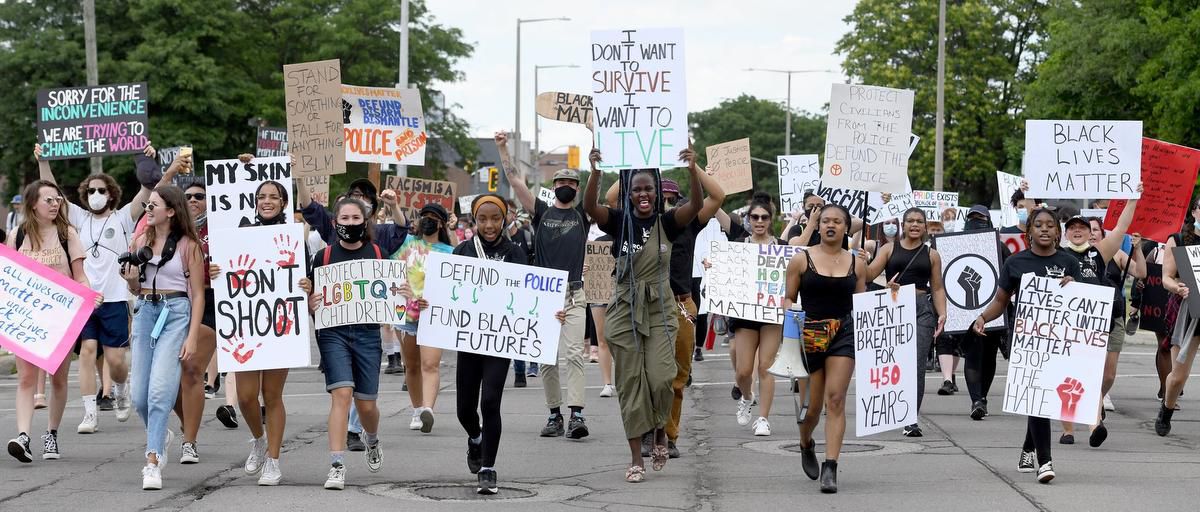
A white police officer’s knee on the neck of an immobilized Black man is a powerful analogy for the State’s violent repression of some of its citizenry. Incidents of police violence caught on video are driving demands for transformative, societal change here in Hamilton, across Canada and around the world. We join that call as we share the pain and righteous rage communities are experiencing in response to this abuse. Canada was founded on racial injustice yet has a long history of denying that racism proliferates in this country. Finally, systemic racism has been acknowledged by government and institutional leaders and a broad coalition of people and organizations is demanding the dismantling of structural inequities. We join others in calling for the implementation of an anti-racism, anti-oppression framework as the foundation for this social change.
Community legal clinics have been working with low income individuals and communities in Hamilton for over forty years. It is our experience, and we know from evidence, that poverty marginalizes people in all aspects of their lives and is a key social determinant of health and inclusion. We also know that people experiencing poverty are disproportionately Indigenous, Black, racialized, female-identifying, people with disabilities including mental health, members of the 2S and LGBTQIAPGNC communities and newcomers.
As a mainstream, government-funded agency, we have been taking a critical look at how we contribute to the perpetuation of colonization and systemic racism and oppression. It is an uncomfortable and unsettling process, one that requires honesty, education, listening, self-reflection and empathy. It requires a deep understanding of the history and current reality of white supremacy and how privilege influences people’s outcomes positively and negatively. It is also inspiring and motivating. We have embarked on a journey to develop and implement a robust Anti-Racism, Anti-Oppression (ARAO) Plan. It is a framework for all decision-making, service delivery, community engagement, policy development and human resources, as well as all personal interactions.
This same ARAO lens must be the approach to transform the criminal justice system. It would influence every decision necessary to design laws, procedure, structures, institutions and processes, including governance, oversight and accountability measures. It would centre diverse people as the architects of change and amplify the voices of those who have been historically disempowered and silenced. It would recognize that the police are only one part of a larger state funded and operated system that must be wholly re-envisioned.
Hamilton Community Legal Clinic supports transformational change of the criminal justice system including investing in decriminalization, disarmament, demilitarization and alternatives to policing. We support the reallocation of resources to community-centred supports, including health, housing, education, youth, social development and programs that improve quality of life and community wellbeing.
We join the call for structural change, as opposed to incremental tweaks. We provide the following as examples of essential reforms. This list is not exhaustive, but illustrates a holistic, ARAO approach to meaningful, transformative change:
The time for change is now. And it must be transformative .


