The Hamilton Community Legal Clinic invites you to our Annual General Meeting and Community Gathering!
Location: Hamilton Central Library – Hamilton Room
Address: 55 York Blvd, Hamilton, ON L8N4E4
Date: Tuesday, September 15, 2026
Time: 5:00 – 7:00pm
Join us for an evening where you can learn about what we do, meet some of our team as well as connect with others who share a commitment to access to justice.
All are welcome.
Light refreshments will be provided.
Print files:
2024-2026_AGR_ENG_Print
Digital files:
2024-2026__AGR_ENG_Digital
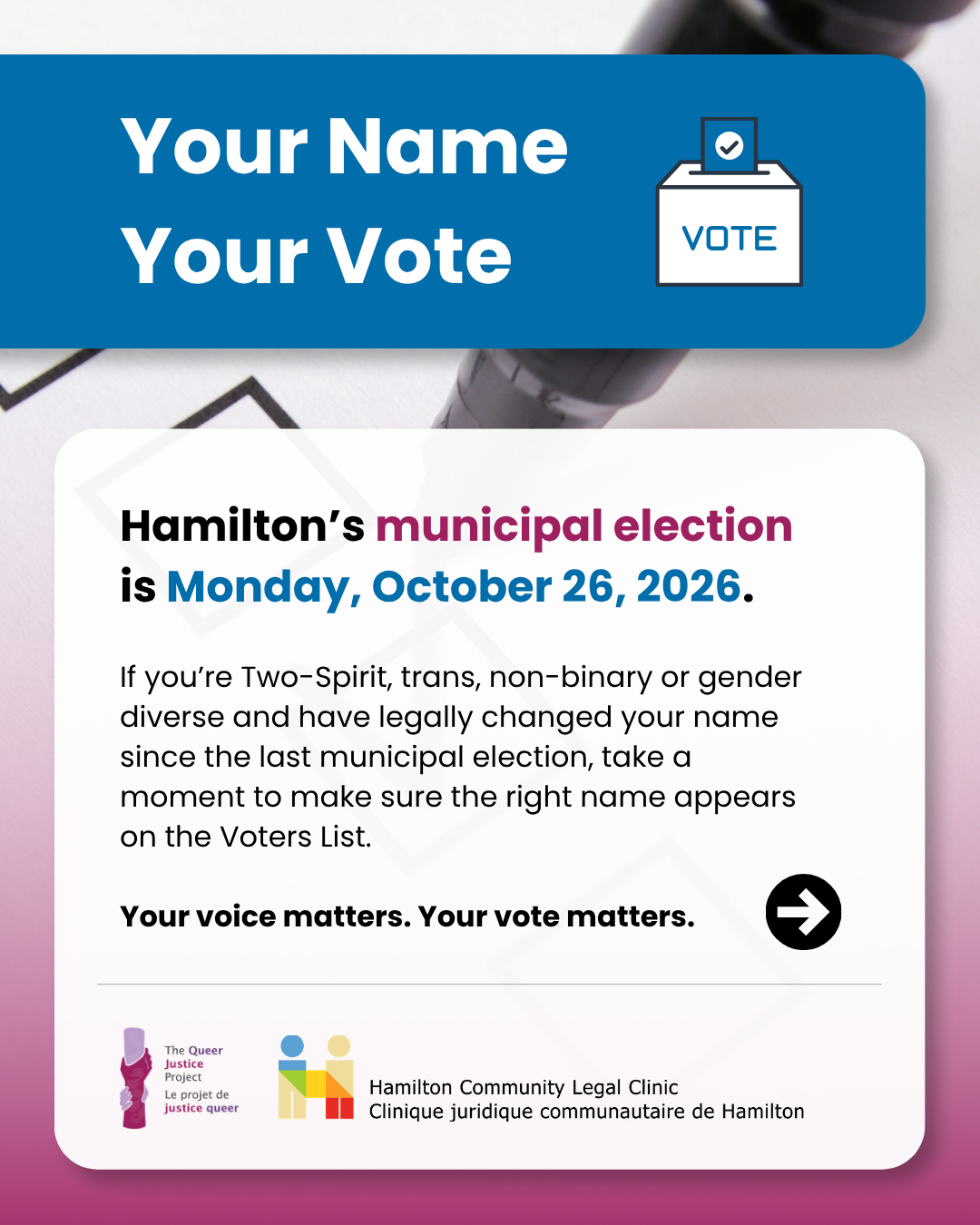
Hamilton’s municipal election is Monday, October 26, 2026.
If you’re Two-Spirit, trans, non-binary or gender diverse and have legally changed your name since the last municipal election, take a moment to make sure the right name appears on the Voters List.
Your voice matters. Your vote matters.
Legally changing your name in Ontario does not automatically update the Voters List.
The City of Hamilton uses voter information provided by Elections Ontario to prepare its Voters List.
If you updated your name with Elections Ontario on or before July 14, 2026, your updated name should appear on Hamilton’s Voters List.
But it’s still a good idea to check.
Starting September 1, you can check whether your name appears correctly on Hamilton’s Voters List by visiting:
Office of the City Clerk
Hamilton City Hall
If your name is missing or incorrect, you can also submit an Application to Amend the Voters List there.
Bring identification and, if you are updating your name, your Change of Name Certificate.
Didn’t get a chance to update the Voters List ahead of time?
You can update your voter information — including your name — at a polling station on any voting day.
Don’t let an outdated name on the Voters List stop you from exercising your right to vote.
You can update your name and other voter information online through Elections Ontario’s Register to Vote service: vreg.registertovoteon.ca
Important: If you updated your information with Elections Ontario after July 14, 2026, that change will not be reflected on the City of Hamilton’s Voters List for this municipal election.
You may still need to update your information directly with the City.
Navigating voter registration after a legal name change can be confusing. You don’t have to figure it out alone.
The Queer Justice Project at Hamilton Community Legal Clinic can provide peer support to Two-Spirit, trans, non-binary and gender diverse community members who want help checking whether their name appears correctly on Hamilton’s Voters List.
Andy Sprung
Queer Justice Project Coordinator
andy.sprung@hclc.clcj.ca
For more information about voting and voter eligibility, visit the City of Hamilton’s municipal election website.
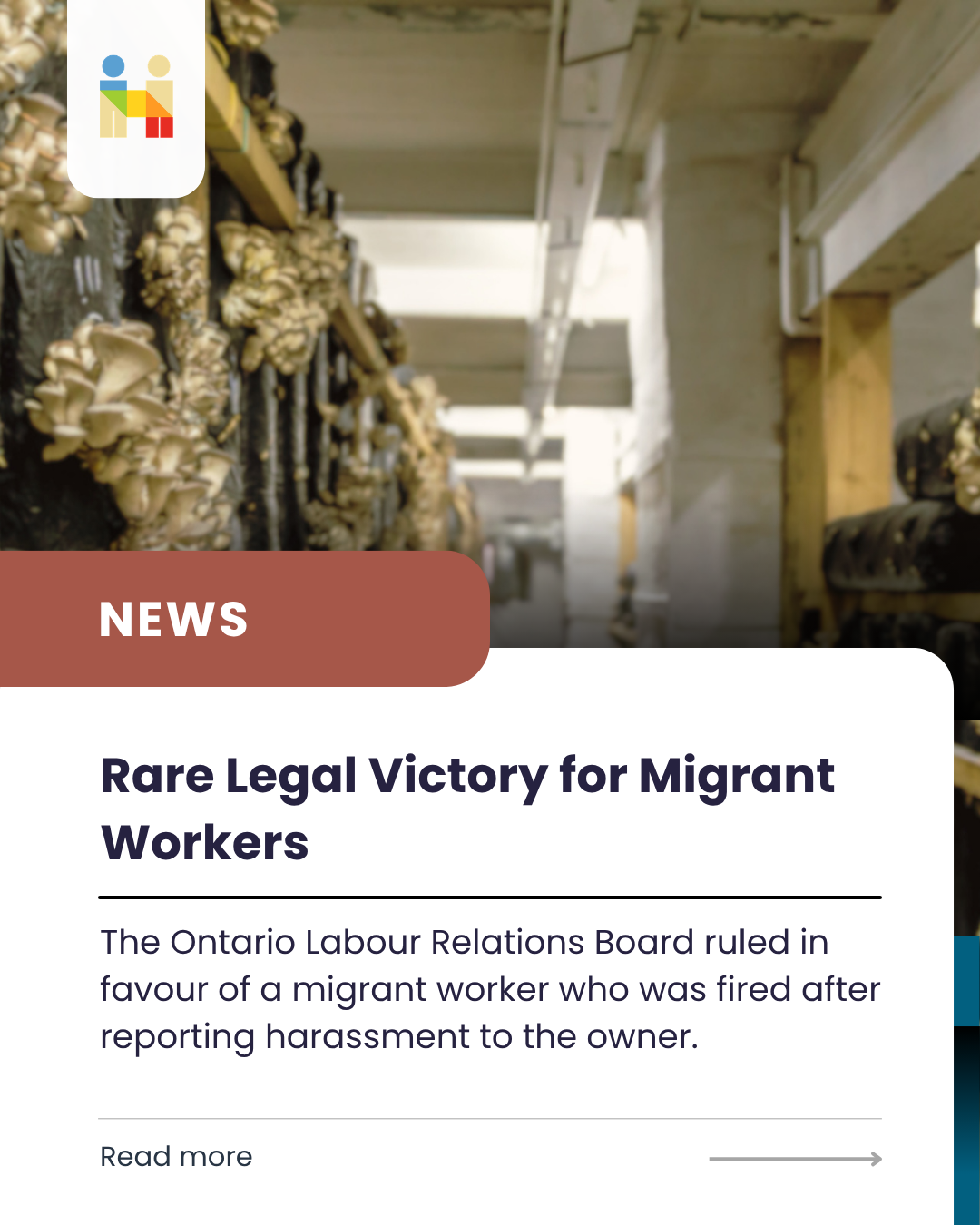
Over the past two years, HCLC has supported a client in her journey towards justice, after reporting harassment and violence at the workplace and being fired in retaliation. This client worked for Nebo Mushrooms in Port Hope as a mushroom picker, after relocating to Canada from China with her son. She experienced bullying and violence on the job by her co-workers, which she reported to her boss. In response, she was put on an unpaid leave of absence and never brought back to work. The employer tried to characterize the end of her employment as her quitting, which was incorrect. In November 2025, after taking this reprisal matter to the Ontario Labour Relations Board, our client received the OLRB’s merits decision, confirming that yes, she had been reprised against by Nebo Mushrooms, in violation of the Occupational Health and Safety Act.
In May 2026, we went back to the OLRB to argue for appropriate compensation for this client. HCLC and its client have been grateful for an outpouring of support from the migrant worker community and allies. Media coverage around the date of the May 26, 2026 hearing has also meant that this serious issue, and the tremendous issues facing newcomer workers in closed work permits, have been made more public. We are hopeful for a remedy award that truly compensates this for what she has gone through.
Read more :
CBC | Migrant worker seeks compensation after labour board rules Hamilton farm wrongfully fired her
Toronto Star | This Ontario migrant worker was fired after she complained about workplace harassment. She just scored a rare legal victory
November Merits Decision: https://www.canlii.org/en/on/onlrb/doc/2025/2025canlii122565/2025canlii122565.html

Our team is hiring to fill an upcoming vacancy created from a maternity leave. The successful candidate for this position will fulfil reception duties by making initial contact with clients, visitors and community; they will elicit, summarize and record intake information from clients. They will also provide general administrative support.
EDUCATION, KNOWLEDGE, SKILLS AND ATTRIBUTES
COMPETENCIES
Compensation: Annual Salary Range $55,000 to $67,000.
Please apply via Charity Village https://www.charityvillage.com/ with resumé and
cover letter no later than Monday, July 27, 2026 at 4:00 pm.
Today, July 14, the Queer Justice Project recognizes International Non-Binary People’s Day.
First observed in 2012, International Non-Binary People’s Day celebrates non-binary people while raising awareness of the barriers they continue to face. The date was intentionally chosen because it falls halfway between International Women’s Day (March 8) and International Men’s Day (November 19), recognizing that gender is not limited to a binary.
Non-binary people have always existed. Yet many continue to encounter discrimination when accessing employment, housing, healthcare, education, and other essential services. Despite important legal protections in Ontario, too many non-binary people still face barriers to having their identities respected, accessing accurate identity documents, and living free from harassment and discrimination.
At the Queer Justice Project, we believe that access to justice means more than access to the courts—it means being able to navigate everyday life with dignity, safety, and respect. Through legal advocacy, public legal education, and initiatives like the Hamilton Trans ID Clinic, we work alongside our communities to remove barriers, challenge discrimination, and help ensure that queer, trans, Two Spirit, and non-binary people can access the rights they are entitled to.
International Non-Binary People’s Day is a celebration, but it is also a call to action. Creating a more just and inclusive community means respecting people’s names and pronouns, challenging anti-trans and anti-non-binary discrimination wherever it appears, and continuing to advocate for systems that recognize and affirm gender diversity.
To all of the non-binary people in our community: thank you for your resilience, your leadership, and your joy. We see you, we celebrate you, and we are proud to stand with you—not just today, but every day.
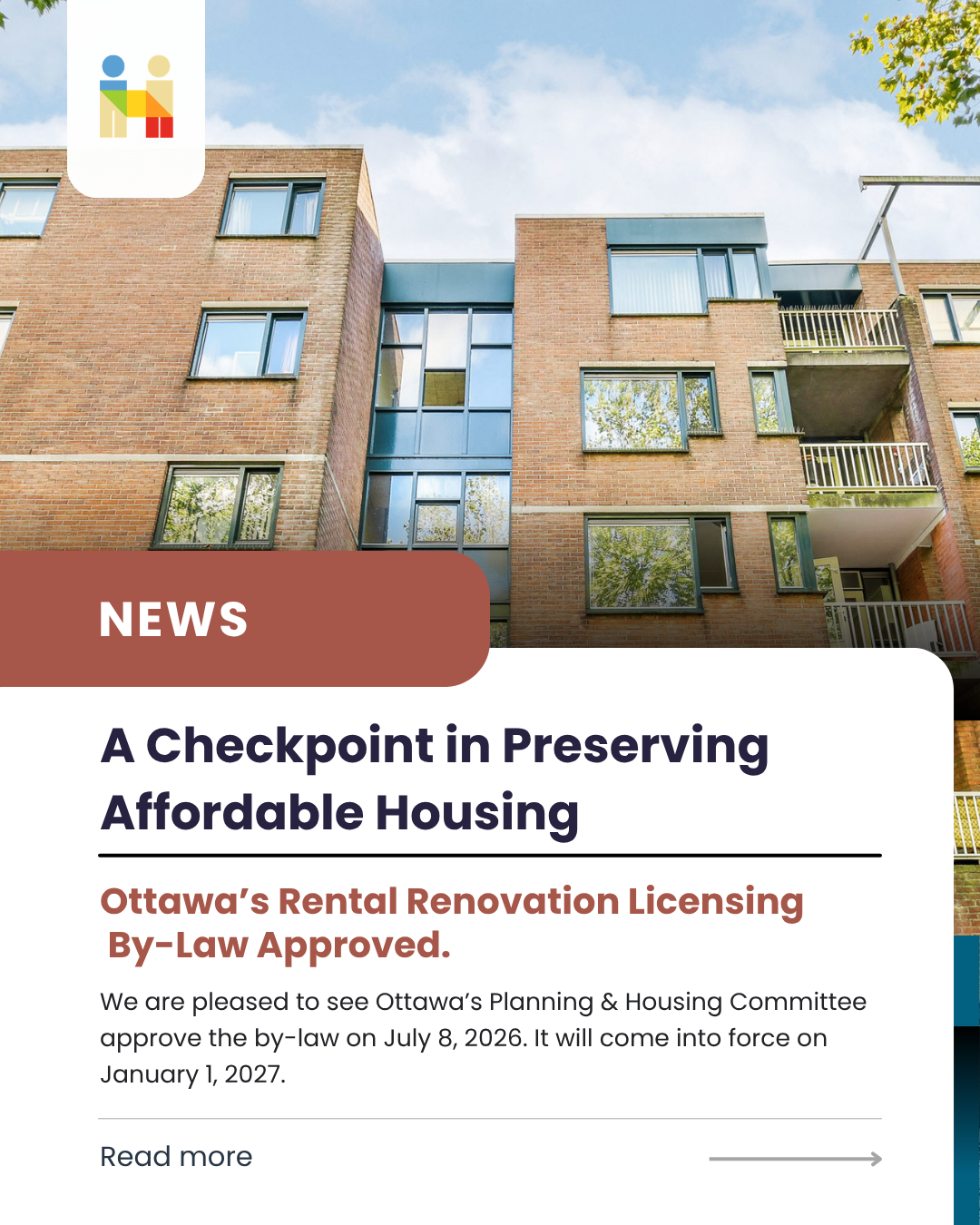
On July 8th, Hamilton Community Legal Clinic delegated in support of Ottawa’s Rental Renovation Licensing By-Law, a critical municipal checkpoint to help deter bad-faith renovictions and protect affordable housing.
We are pleased to see Ottawa’s Planning & Housing Committee approve the by-law on July 8, 2026. It will come into force on Jan 1, 2027.
Hamilton’s experience demonstrates that renoviction licensing works. Since Hamilton’s Renovation License and Relocation By-law came into effect, displacement by N13’s decreased by 80% and the numbers justify what tenant advocates have long said: when landlords are required to obtain permits, justify vacant possession, inform tenants and comply with relocation protections, bad-faith N13’s are deterred.
This kind of by-law does not prevent necessary repairs. It ensures that renovations are not used as a mechanism for displacement, rent gouging or the permanent erosion of affordable housing.
Tenant protection means affordable housing preservation.
Hamilton Community Legal Clinic is proud to stand with tenants, community advocates like ACORN (Association of Community Organizations for Reform Now) who were instrumental in advocating for this by-law and municipalities taking meaningful action to preserve affordable housing across Ontario.
Read more at CTV News: City committee approves Renoviction Bylaw to deter bad faith evictions in Ottawa: https://www.ctvnews.ca/ottawa/article/city-committee-approves-renoviction-bylaw-to-deter-bad-faith-evictions-in-ottawa/
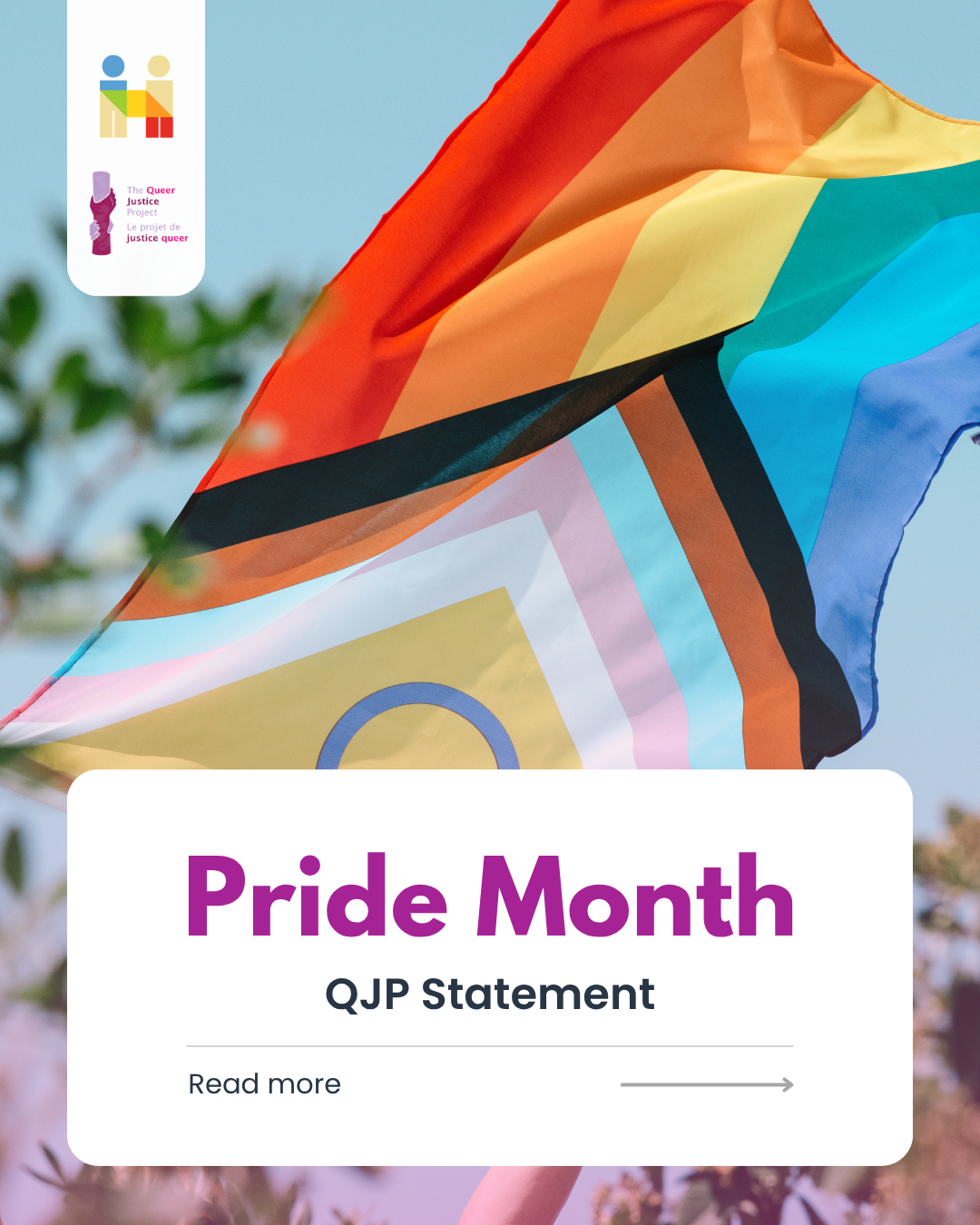
Pride Month is a celebration, but it is also a reminder of the ongoing struggle for equality, dignity, and justice.
In Hamilton, Pride celebrations have often been met with resistance.
When Hamilton’s first Pride celebrations were organized by the Hamilton Gay and Lesbian Alliance (GALA) in 1991, then-Mayor Bob Morrow refused to issue a civic proclamation recognizing Pride. GALA challenged that decision through the Ontario Human Rights Commission and won. The ruling affirmed that queer and trans communities were entitled to equal recognition and respect under the law.
Nearly three decades later, Hamilton’s 2019 Pride celebration at Gage Park was disrupted by organized anti-queer and trans protesters. Community members were subjected to harassment and violence. An independent review later found significant shortcomings in the police service’s planning and response intended to keep attendees safe.
These moments are part of Hamilton’s history, but they are not simply history. Across our city and country, we continue to see rising hate incidents, the spread of anti-queer and trans rhetoric, legislative attacks on the fundamental Charter rights of trans people, and public demonstrations by white supremacist and far-right groups. Many queer and trans people continue to face discrimination, harassment, violence, and barriers to accessing justice.
That is why Pride still matters.
Pride is a celebration of community, joy, and resilience. It is also a declaration that everyone deserves to live openly, safely, and with dignity. While progress may not always be linear or inevitable, Pride reminds us of what is possible.
As a community legal clinic, we recognize that access to justice is inseparable from the fight for human rights. We are committed to supporting queer and trans communities, challenging discrimination, and standing alongside those working to build a Hamilton free from hate and exclusion.
This Pride season, we honour the activists who fought for recognition, the community members who stood together in the face of hate, and all those who continue the work of building a more just and inclusive city.
Happy Pride season, Hamilton. We look forward to seeing you at Pride Hamilton in August!
Our team is hiring a housing lawyer for our Tenant Support Program team. This unique program involves delivery of legal services in addition to working closely with community partners to provide support and education. The successful candidate will work alongside a paralegal and law clerk within the legal clinic to provide housing law services with a focus on N12, N13, AGI matters. This is a full time position, subject to funding through the City of Hamilton.
Qualifications Include:
Compensation: Annual Salary Range – $88,000 -91,000 plus benefits and pension plan.
Please apply via CharityVillage with resumé and cover letter no later than Thursday, April 30th, 2026: https://www.charityvillage.com/job/law-clerk-255424
As part of our work against racism and other oppressions, we strive to reflect the diversity of the communities we serve. We encourage racialized, First Nation, Métis and Inuit applicants as well as applicants with French Language skills.
We thank all applicants, but only those candidates selected for an interview will be contacted.
Since 2010, Hamilton Community Legal Clinic/Clinique juridique communautaire de Hamilton (HCLC/CJCH) has been dedicated to promoting access to justice and improving quality of life for our clients. We do this by providing legal advice and representation, community development and public legal education to low-income individuals and communities in Hamilton. We are looking for community-focused individuals with a keen interest in social justice to guide our next chapter.
Board members must live or work in Hamilton. They are responsible for determining the strategic direction of the clinic, ensuring accountability to funders and the community and stewardship of HCLC/CJCH’s mission, vision and values. HCLC/CJCH’s board is focused on governance rather than operations.
To apply, please reach out to Teresa Workman at Teresa.Workman@hclc.clcj.ca .
For more information about our Board of Directors, you can visit our BOD webpage: https://hamiltonjustice.ca/en/governance .
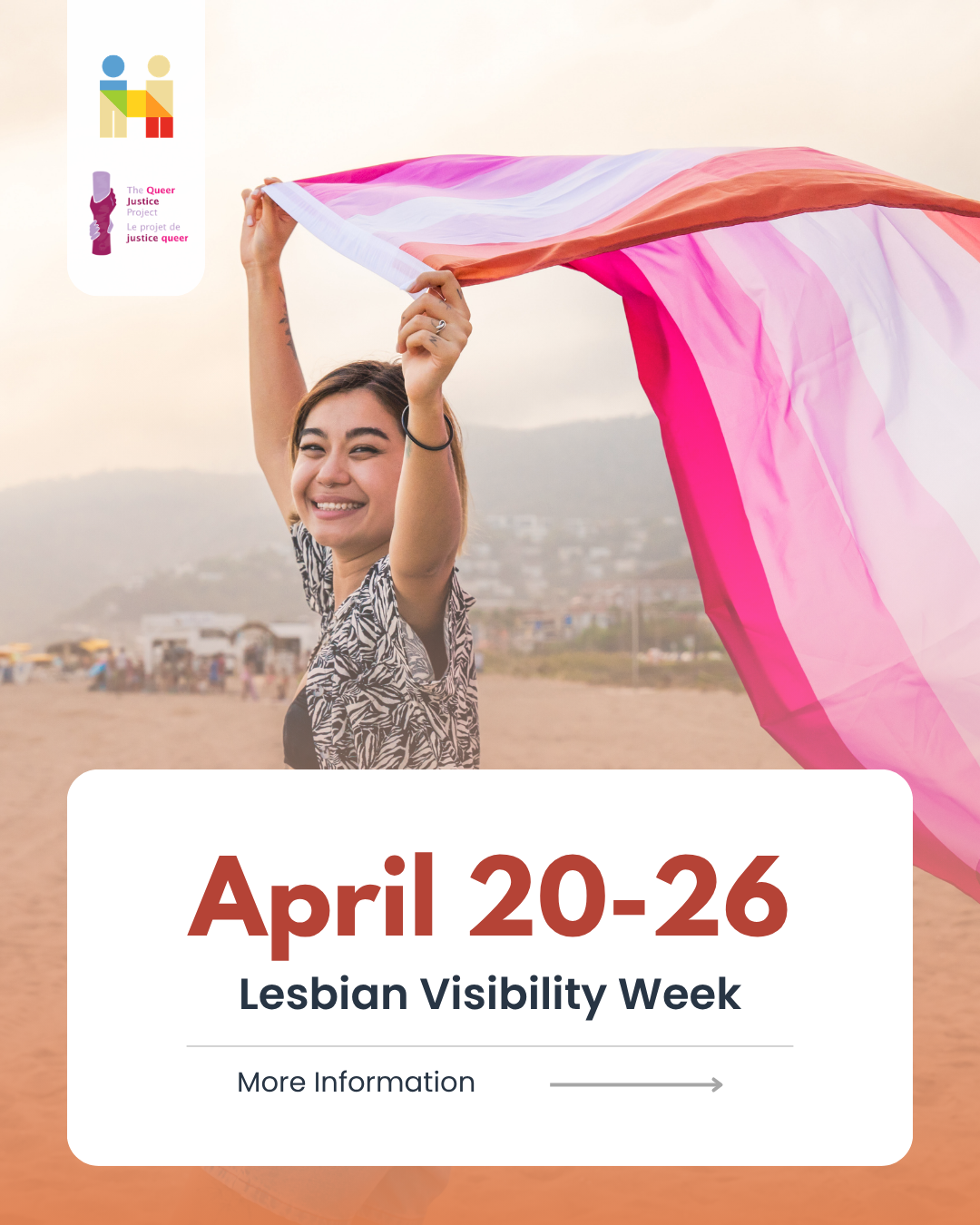
Happy Lesbian Visibility Week!
Today we’re celebrating not just visibility, but the rich and deeply rooted history of lesbian communities right here in Hamilton, Ontario.
The Women’s Bookstop, opened in 1985 as Hamilton’s first feminist and queer bookstore, became a vital hub for connection and activism. More than a bookstore, it was a gathering place where women and queer communities could meet, organize, and imagine new possibilities. It hosted events, supported feminist publishing networks, and created a rare space where lesbian lives and stories were visible and valued.
Around the same time, the Hamilton Gay and Lesbian Alliance (GALA) played a key role in building 2SLGBTQ+ community in the city. When GALA started Hamilton Pride in 1991, Mayor Bob Morrow refused to issue a formal civic proclamation recognizing it, something which was commonly done to promote significant events in the city. In response GALA brought and won an Ontario Human Rights Commission complaint against the city.
Lesbians have also played a critical and often under-recognized role in 2SLGBTQ+ history during the AIDS crisis. In Hamilton and beyond, lesbians showed up as caregivers, organizers, and advocates: raising funds, providing care, fighting stigma, and building support networks when many others turned away. Their leadership and compassion helped sustain communities through one of the most devastating public health crises of our time.
This history matters right now. At a time when Hamilton’s queer and trans communities are facing renewed backlash and rising hate, these stories remind us what collective care, resistance, and solidarity look like. The generations before us didn’t wait for acceptance — they built community anyway, defended each other, and demanded better. Their legacy is not just something to remember, but something to carry forward. Lesbian Visibility Week is a chance to honour that past while recommitting to the work ahead — to protect, uplift, and stand alongside queer and trans people in Hamilton today.
Our history matters. Our spaces matter. We are still here.
Sources:


